
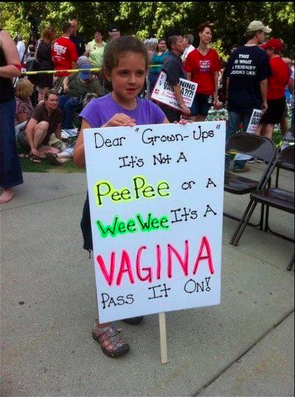
 Let me just say up front that we will be referring to body parts in this article. If that will freak you out, this is your chance to close your browser window and skip this week’s post. It’s ok, go ahead and bail.
Let’s also get the terminology straight here. We will be referring to male parts as a penis and testicles and the girl parts as a vagina and ovaries. These are their real names. Learn to use them.
Ever heard the phrase “grow a pair”? I bet you have. Let’s talk about why that’s not the best phrase to use and what you could be saying instead.
For the non-native English speakers among us, the phrase “grow a pair” refers to male testicles. It is meant as a way to say “be courageous”. It implies that if you’re going to be strong you have to be male or show male characteristics.
Urban dictionary defines it as “‘Telling someone they don’t have the balls that they SHOULD have to do something ‘manly'”.
I call BS on that notion. The Girls Can’t WHAT? Site is full of courageous women, but that is just a side note for the moment.
So basically when you say “grow a pair” you’re telling that person to “be a man”. You’re reinforcing the stereotype that men are stronger and more courageous. Anyone who has read through this site knows that women are equally as strong and courageous. It’s a gender stereotype that needs to be put to rest.
So next time you feel the need to say “grow a pair” to someone, you might want to specify whether that should be a pair of testicles or a pair of ovaries.

34 comments
Stel
I said it to my exboyfriend, because he was degrading me as a woman not accepting reality…to act as a man for once. Oh, sometimes one needs to say it in RARE occasions.
Nate
If you’re told to grow a pair, own it. Both females and males have gonads -Males/testicles. Females/ovaries. Growing a pair is as sexist as you allow it to be. Literally, woman CAN and do grow a pair!
Women and their allies have many battlefields to achieve victory on. Might as well skip the battle and enjoy the victory biology gave you on this one. Balls For All!!!
Joe Avragepoulos
Those who say “never say grow a pair” seriously need to grow a pair.
But maybe wom– little girls really can’t take it. They’re fragile, sweet little things and we should make every effort to not hurt their feelings with our dirty mouths.
It’s time for a new feminism that accepts that wo/girls are delicate flowers that need to be put in a pedestal and treated like the princesses they are. Old-fashioned feminism had that girls were equally strong, not needing to cry for every little thing, but this is simply wrong, it ignores girl’s inherent emotional frailty.
Only an over-protective, smothering motherly society, will be able to help girls achieve all the dreams their hearts desire. ♥♥♥♥♥♥
Never say “grow a pair”, but “put your princess crown/tiara”. Wear it and start giving orders to the world, just yell for what you’re entitled to — which is, absolutely anything, you’re all princesses of the whole world.
Random boy
Grow a pair and write something useful. And to all the females that agree with the blog and writing long posts, way to emphasize your love for drama, giving people a good reason to say calm your tits and shit.
Margaret
Calm your boner dude! So defensive, so aggresive.
Janis
“Have some courage” pretty much nambi-pambifies the sentiment. I’m all ears for alternatives. All I can think of is an addition, say, like, “Grow a pair, cut one off and shoot already.”
The danger of the phrase, IMHO, isn’t so much the the sexist implication so much as it is an expression of unrecognized impatience. There is a testosterone issue here: for good or ill, young boys tend to be louder and more disruptive. When young girls can’t shout over them, repeatedly, they adapt by forming smaller groups and fewer, more intimate relationships in order to feel heard. Maybe instead of using the phrase with our mouths, we turn it around and remind ourselves to grow a pair of ears.
Zephaniah Greenwell
“Let me just say up front that we will be referring to body parts in this article. If that will freak you out, this is your chance to close your browser window”… turn off your computer, unplug it, light it on fire, and throw it out the window. This is the internet. Seriously, how have you lasted this long?
Mirabelle
hi! Please refrain from using the phrase “male parts” as a phrase for the testes/penis. Some women (transgender women) have a penis, and using those phrases reduces them to their genitals. Vice versa for trans men. Thank you!
thomas2053
so your saying that girls are as strong as men?! you ain’t right in the head! completely NOT true, look at them bodybuilders, don’t girls seem a little MASSIVE bit smaller!?
thomas2053
nice!
Ugly Truth
It’s obvious you can’t grow balls but sadly it seems you can’t grow a brain either. Men are from Mars and wemen are from Venus. They are born with their differences. Learn to appreciate for what they are rather than trying to equate. Men are different from women – for a reason. Period.